
Mass spectrometry, without the jargon
Mass spectrometry is the lab technology BioTwin uses to read more than 30,000 biomarker-derived metabolic signals from a finger-prick Bio-Signature sample. Here is how it works, in plain language.
What it does
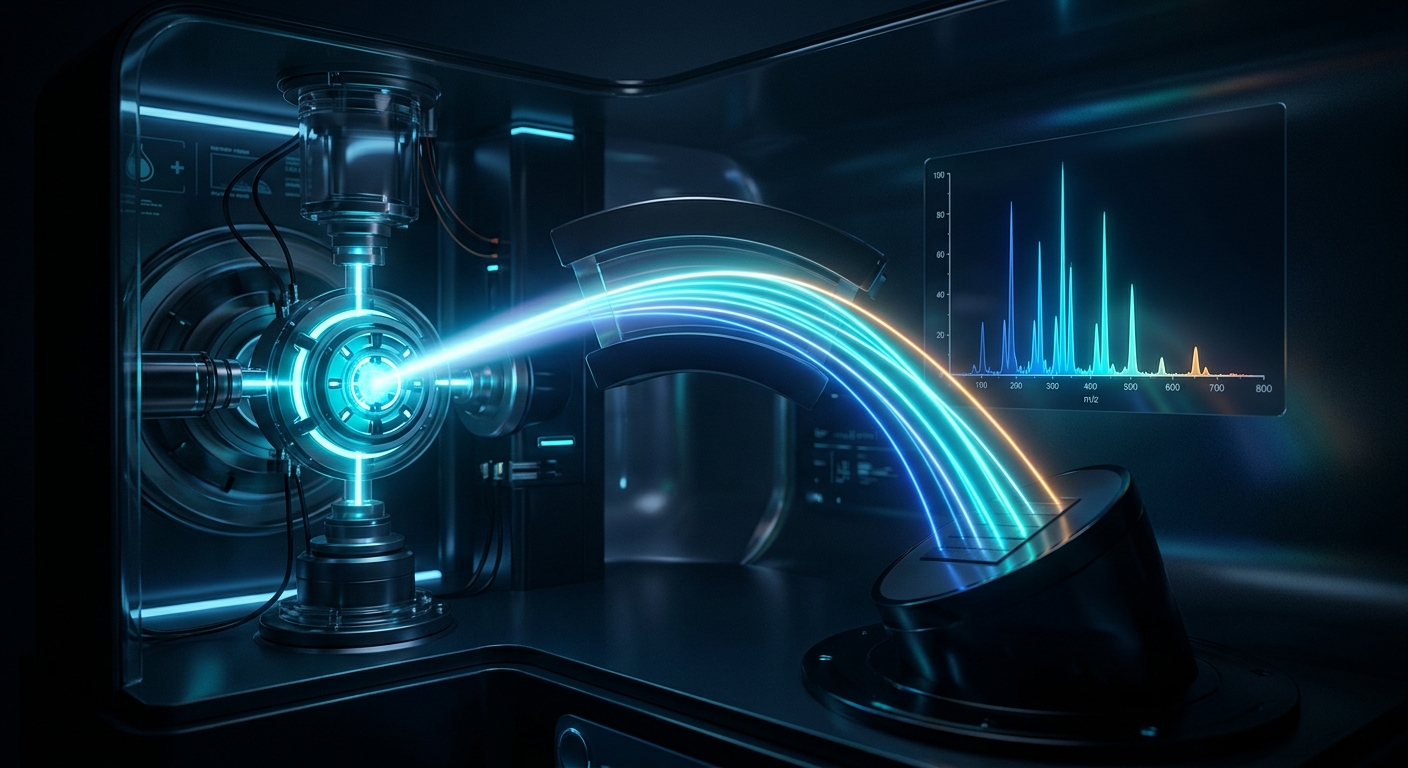
Mass spectrometry sorts molecules by their mass and fingerprints each one. A few drops of blood from a finger prick are not a single substance. They are a mixture of thousands of different biomolecules, each with its own shape and weight. A mass spectrometer separates them, weighs them, and helps identify them.
The simplest way to picture it is a very precise molecular scale. The molecules are given an electric charge, then sorted by the ratio of their mass to that charge, and the instrument records how much of each it detects. That record is called a spectrum. Each peak in the spectrum corresponds to a family of molecules with a specific mass, which can then be matched to a known biomarker.
Why one analysis yields more than 30,000 biomarker-derived metabolic signals
Mass spectrometry is an untargeted method: it does not need to be told in advance which molecules to look for. Instead of asking "how much of this one molecule", it asks "what does this sample contain". Its immediate output is a high-dimensional metabolic signal profile: a single analysis yields more than 30,000 biomarker-derived metabolic signals.
Those signals feed the BioTwin model; each program then organizes its results into Bio-Signatures that group biomarkers related to the same health or well-being dimension.
What it takes to run it
Mass spectrometers are complex machines. They need to be calibrated carefully, run by trained operators, and maintained constantly. The raw output is not directly readable by humans either: it takes a serious data pipeline to extract biomarkers, normalize them, and turn them into scores that mean something.
BioTwin has invested in that full pipeline, from sample handling to reference data and the scoring models that power your virtual twin, so that a broad metabolic profile can be offered through TwinMe. See current prices on TwinMe.